Summary
We conduct scientific studies on public opinion and behavior; inform the decision-making of governments, media, companies, and advocates; educate the public about climate change; and help build public and political will for climate action.
Global warming is one of the greatest threats – and opportunities – of the 21st century. Our fate will be determined by the choices of 8 billion people and counting. We are social scientists studying the causes and consequences of public opinion and behavior. We help governments, media, companies, and advocates communicate more effectively. And we publish an online climate news service and daily national radio program, Yale Climate Connections.
The Yale Program is directed by Dr. Anthony Leiserowitz. For more information about the YPCCC team, please see People & Partners. The Program is part of the Yale School of the Environment at Yale University, in New Haven, Connecticut.
OnAir Post: Yale Program on Climate Change Communication
About
X
Web Links
Yale Climate Connections
Yale Climate Connections is a climate news service, daily radio program, and podcast providing original reporting and commentary on climate change.
Visit Yale Climate Connections to learn more.
Climate Change in the American Mind
Source: Website
Public opinion plays a critical role in the American response to global warming. Our twice a year Climate Change in the American Mind nationally representative surveys investigate, track, and explain public climate change knowledge, risk perceptions, policy support and behavior. Our findings are published in numerous reports and peer-reviewed articles and are cited by leading news organizations, academic journals, and online media around the world.
The most recent reports, from our surveys conducted in 2021 – 2023, are:
Climate Change in the American Mind: Beliefs and Attitudes, Spring 2023
Climate Change in the American Mind: Beliefs and Attitudes, December 2022
Climate Change in the American Mind, Politics & Policy, December 2022
Politics and Global Warming, April 2022
Climate Change in the American Mind, April 2022
Consumer Activism on Global Warming, December 2021
Climate Change in the American Mind, November 2021
Public Support for International Climate Action, October 2021
Politics & Global Warming, October 2021
Americans’ Actions to Limit and Prepare for Climate Change, August 2021
Climate Change in the American Mind, June 2021
Public Support for International Climate Action, March 2021
Politics & Global Warming, March 2021
Our surveys—conducted in partnership with the Center for Climate Change Communication at George Mason University—are the most comprehensive of their kind and draw on the leading scholarship and survey research expertise of our multidisciplinary staff and partners. Our findings provide insights vital to the design of effective climate change education and communication campaigns conducted by local, state, and national governments, environmental organizations, academic institutions, businesses, faith groups, doctors, and scientists.
Our research has identified “Global Warming’s Six Americas,” six unique target audiences in the U.S. that respond to climate change in different ways. Understanding these Six Americas—from the “Alarmed” (Americans who are very worried about global warming and are taking action) to the “Dismissive” (those who think global warming is non-existent, not a threat, or an outright hoax)—has been critical to the efforts of NGOs, advocates, government organizations, and others seeking to better communicate the threat of global warming to their constituencies. The surveys have greatly advanced our understanding of the psychological, cultural, and political drivers of American climate change attitudes, policy preferences, and behaviors.
State and Local Studies
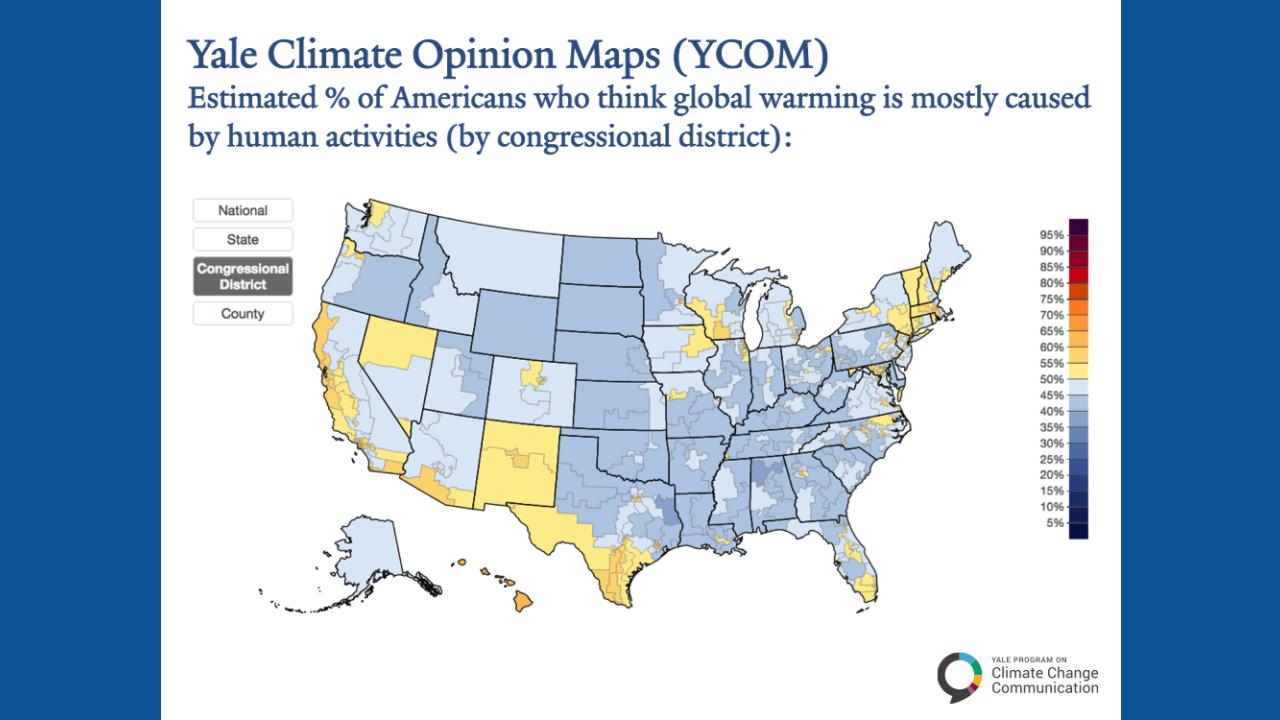
We also conduct representative state and local surveys to gain a deeper understanding of how different parts of the country, and different audiences, think about climate change. Examples include our Yale Climate Opinion Maps and individual studies in Alaska, California (including an in-depth survey of San Francisco), Colorado, Florida, New York City, Ohio (including an in-depth survey of Columbus), and Texas.
Working with local governments and academic institutions, we conducted the largest-scale surveys about climate change ever executed in two major carbon-emitting countries—India and China—whose actions are vital to successful efforts to curb global warming:
The Climate Literacy Project
As a supplement to the Climate Change in the American Mind surveys, we conducted a large-scale national survey assessment of adult and 6-12 grade students’ understanding of the climate system and the causes, consequences, and potential solutions to climate change. This project provided a baseline assessment for climate change educators across the United States and an evaluation tool for educators to assess and track improvements in climate literacy among students and public audiences. We published several reports based on the findings:
- Americans’ Knowledge of Climate Change
- Knowledge of Climate Change Across Global Warming’s Six Americas
- American Teens’ Knowledge of Climate Change
- Knowledge of Climate Change Among Visitors to Science & Technology Centers
Our Projects
- Partnerships Program
- Public Voices Fellowship on the Climate Crisis
- Climate Change in the American Mind
- Global Warming’s Six Americas
- Identifying Climate Messages That Work
- Engaging Latinos in the U.S. on Climate Change
- Heat Wave Risk Perceptions
- Partnership with Pulitzer Center for Crisis Reporting
- Yale Climate Connections
- International Attitudes & Behavior
- Yale Climate Opinion Maps
Wikipedia
The Yale Program on Climate Change Communication (YPCCC) is a research center within the Yale School of the Environment that conducts scientific research on public climate change knowledge, attitudes, policy preferences, and behavior at the global, national, and local scales. It grew out of a conference held in Aspen, Colorado, in 2005.[1]
General
The program is led by Anthony Leiserowitz.[2] As of 2017, it put out a daily 90 second audio program carried by around 350 radio stations, articles in the media, a series of monthly videos, and training to help television weather presenters and reporters discuss climate change.[3] The organization conducts ongoing opinion polls of the American public on climate. Its climate change opinion polling has been described as being similar to the work of the Pew Research Center.[2] The YPCCC website also offers tips on how activists and everyday people can communicate more effectively about climate change.[2]
YPCCC has collaborated with the George Mason Center for Climate Change Communication to assemble a freely available dataset, which has been used to create interactive partisan climate opinion maps of the United States.[4][5][6] These maps, also known as the Yale Climate Opinion maps, provide detailed information about "climate change beliefs, risk perception and policy support for climate-related policy at the state and local level."[7] In July 2019, the organization suggested that discussing climate change more frequently with family and friends might be the most effective way of influencing United States public opinion on climate change.[8][9]
YPCCC partnered with John F. Marshall's Potential Energy Coalition on the "Later is Too Late global report," which conducted global message testing research on demand for climate action.[10]
Awards
In 2017 the program was given a "Friend of the Planet" award by the National Center for Science Education in 2017.[11] In 2018, Leiserowitz and YPCCC researchers received the Warren J. Mitofsky Innovators Award, given by the American Association for Public Opinion Research. The award recognized "a new statistical method to downscale national public opinion estimates using multiple regression and post stratification (MPR) survey data collection methodology".[12]
Yale Climate Connections
Yale Climate Connections is an online news site, YouTube channel, and radio program produced by the Yale Program on Climate Change Communication to disseminate information about climate. It is funded by various foundations, Yale University alumni, and the general public but receives no direct funding from the university.[13]
References
- ^ "About the Program". Yale Program on Climate Change Communication. Retrieved April 2, 2018.
- ^ a b c Zhang, Sharon (June 19, 2019). "How Climate Activists Can Communicate Better". Pacific Standard. Retrieved August 3, 2019.
- ^ Abraham, John (August 14, 2017). "Great climate science communication from Yale Climate Connections". the Guardian.
- ^ University of California Santa Barbara, Eureka Alert! American Academy of Sciences (February 16, 2019). "Political and policy feedbacks in the climate system. Climate Change: Understanding feedback from nature, culture and society". Archived from the original on August 3, 2019. Retrieved August 2, 2019.
- ^ Mildenberger, Matto; Marlon, Jennifer R.; Howe, Peter D.; Leiserowitz, Anthony (December 1, 2017). "The spatial distribution of Republican and Democratic climate opinions at state and local scales". Climatic Change. 145 (3): 539–548. doi:10.1007/s10584-017-2103-0. ISSN 1573-1480. S2CID 158303016.
- ^ Leiserowitz, Anthony; Jennifer R. Marlon; Mildenberger, Matto; Howe, Peter D. (June 2015). "Geographic variation in opinions on climate change at state and local scales in the USA". Nature Climate Change. 5 (6): 596–603. doi:10.1038/nclimate2583. ISSN 1758-6798.
- ^ Bolstad, Erika (March 21, 2017). "Maps Show Where Americans Care about Climate Change". Scientific American. Retrieved August 3, 2019.
- ^ Rosen, Julia (July 8, 2019). "Q&A: Want to do something about global warming? Talk about it with your family and friends". Los Angeles Times. Retrieved August 3, 2019.
- ^ Leiserowitz, Anthony; Maibach, Edward; Linden, Sander van der; Goldberg, Matthew H. (July 23, 2019). "Discussing global warming leads to greater acceptance of climate science". Proceedings of the National Academy of Sciences. 116 (30): 14804–14805. doi:10.1073/pnas.1906589116. ISSN 0027-8424. PMC 6660749. PMID 31285333.
- ^ Marshall, John (October 31, 2024). "Later is Too Late to Act on Climate Change - Global Report". Potential Energy Coalition. Retrieved November 26, 2025.
- ^ "Press release: Friend of Darwin and Friend of the Planet awards for 2017". NCSE. February 13, 2017.
- ^ "Award Winners". Archived from the original on July 22, 2018. Retrieved August 30, 2018.
- ^ "About Us". Yale Program on Climate Change Communication. 2026. Retrieved February 26, 2026.
Further reading
- Ballew, Matthew T.; Goldberg, Matthew H.; Rosenthal, Seth A.; Gustafson, Abel; Leiserowitz, Anthony (April 23, 2019). "Systems thinking as a pathway to global warming beliefs and attitudes through an ecological worldview". Proceedings of the National Academy of Sciences of the United States of America. 116 (17): 8214–8219. doi:10.1073/pnas.1819310116. ISSN 1091-6490. PMC 6486745. PMID 30962375.
External links
| International | |
|---|---|
| National | |